
Trump’s GOP Just Drew the Battle Lines
From Obamacare subsidies to Ukraine’s elections to who owns Hollywood, Trump and his allies spent the day forcing real choices: freedom vs control, voters vs bureaucrats, competition vs cartel.

Today was not a “slow Tuesday” in the 47th presidency.
In the Senate, Republicans finally stopped playing defense on health care and moved a Crapo–Cassidy plan that rips power away from insurance companies and shoves it into patient-controlled accounts — a clear break from the Democrats’ forever-Obamacare subsidy model. That’s the main battlefield.
Around it, Trump is tightening the vise: publicly pressing Ukraine to actually hold elections if it wants to call itself a democracy, backing a Pentagon that’s rewriting woke-era personnel rules, and positioning himself as the ultimate referee in the Netflix–Paramount–Warner Bros brawl for control of the culture machine. Different arenas, same theme — he’s making every player choose a side.

Trump’s Senate Puts Obamacare Subsidies on Trial
On Thursday, the Senate isn’t just voting on health care — it’s voting on whether Trump’s GOP is the party of passive extension or active disruption.
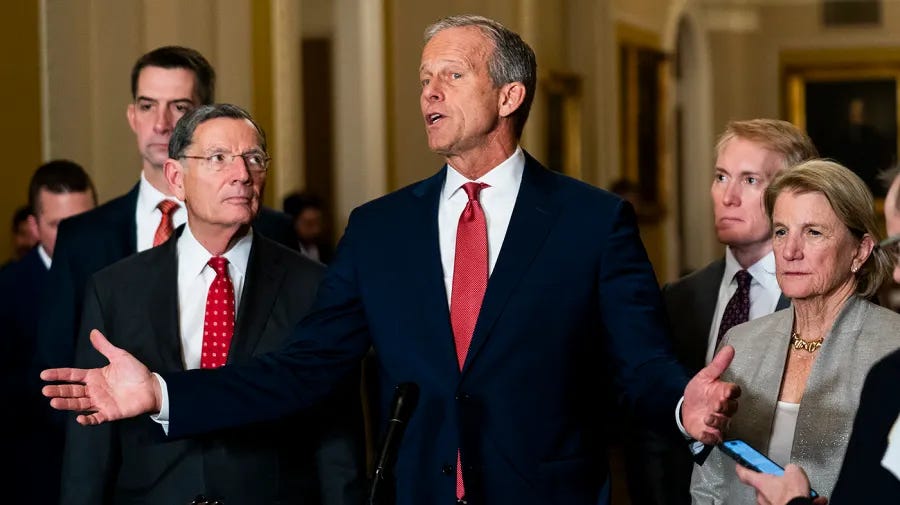
Here’s the setup: Democrats want a clean three-year extension of juiced-up Obamacare subsidies that are set to expire in January. Premiums are about to spike by double digits for millions on the ACA exchanges, and Dems want to posture as the only adults “preventing chaos.”
John Thune just blew that narrative up.
Under heavy pressure from inside his own conference, Thune gave Republicans what they demanded: a vote on a GOP alternative — the Crapo-Cassidy plan — side by side with the Democrat bill. That means vulnerable Republicans don’t have to choose between “Do nothing” and “Vote with the Left.” They can now say: We backed lower premiums, but in a way that empowers patients, not insurance companies.
The Cassidy–Crapo proposal takes the enhanced ACA subsidies and converts them into federally backed Health Savings Accounts. Instead of pouring money straight into insurance plans, the cash goes into accounts controlled by individuals to pay out-of-pocket costs. According to CBO, Republicans are armed with two killer talking points: double-digit premium reductions and nearly $30 billion in federal savings.
Behind the scenes, this move also settles a brewing family fight. Rick Scott wants Trump-branded Health Freedom Accounts. Collins and Moreno want a trimmed-down extension with means-testing and a $25 minimum “skin in the game” premium. Marshall, Husted, others all had their own blueprints. Thune had to pick a lane — and he chose the plan with majority GOP support that most clearly contrasts with the Democrats’ pure subsidy model.
So Thursday’s vote is bigger than one bill: it’s a live-fire test of Trump-era health policy branding. Do Republicans stand for permanent government subsidy pipelines, or for shifting power and dollars into consumer-directed accounts? The vote will tell you who’s serious about the “freedom” part of health freedom — and who just wants to survive the next attack ad.
RECEIPTS:
• Senate to vote Thursday on both the Democratic subsidy extension and the GOP Crapo–Cassidy alternative.
• Cassidy–Crapo converts enhanced ACA subsidies into HSAs with federal contributions, aimed at ACA marketplace enrollees.
• CBO: GOP plan claims double-digit premium reductions and roughly $30 billion in federal savings.
• Multiple competing GOP ideas: Scott’s Trump Health Freedom Accounts, Collins–Moreno’s means-tested extension, separate plans from Marshall and Husted.
• Thune cut this deal after agreeing to give Democrats their subsidy vote as part of the government funding deal that ended a 43-day shutdown.
This isn’t just about next year’s premiums — it’s about whether the Trump GOP defines itself as the party of permanent Obamacare subsidy management or of patient-centered, account-based health freedom.
On Thursday, Democrats vote to prop up the system; Trump’s Senate votes to rewrite the terms of the deal.

FIELD INTEL
Trump to Zelensky: Time for an Election
Trump just put public pressure on Zelensky by saying it’s “time” for Ukraine to hold a presidential election, war or not. He’s framing Kyiv’s canceled 2024 vote as a democracy problem, not just a logistics issue under martial law. That does two things at once: challenges Zelensky’s “defender of democracy” branding and signals to Europeans and Republicans at home that Trump wants accountability before more blood and more money. With polling already showing Ukrainians souring on Zelensky long-term, Trump is essentially asking: if this is a democracy, why is the ballot box on hold indefinitely?
Hegseth Policy Survives Equal Protection Attack (For Now)
An appeals court just handed Trump and Defense Secretary Pete Hegseth a major win by letting their transgender service policy stay in place while litigation continues. The panel basically said: the military gets deference, this isn’t clear-cut “discrimination,” and recent Supreme Court precedent on medical regulation backs them up. The Left is screaming “equal protection,” but the legal trend is moving toward treating this as a readiness/medical standards question, not identity politics. That matters: if this framing holds, it gives the Trump Pentagon wide latitude to reshape personnel policy on its own terms.
Trump Stays Above the Netflix–Paramount–Warner Knife Fight
Hollywood is in a full corporate knife fight: Netflix has a monster deal on the table for Warner Bros., and Paramount has stormed in with a hostile counterbid backed in part by Jared Kushner–aligned money. Trump’s line? None of the players are “particularly good friends” of his, and he’s signaling skepticism that the Netflix mega-merger even clears antitrust review. Translation: he’s keeping leverage. By staying formally neutral while questioning consolidation, Trump keeps all sides courting him, protects his jobs-and-competition message, and leaves himself room to bless, block, or reshape the final deal. Every CEO in this fight now has to campaign to the Oval.


Mon night (Dec 8) – Trump says he’ll personally be involved in reviewing Netflix’s $80+ billion bid for Warner Bros., warning their combined streaming share “could be a problem” on antitrust grounds.
Late Mon → early Tue – Paramount answers with a hostile counterbid for Warner, backed in part by Jared Kushner’s Affinity Partners, turning Trump into the de facto referee over which media giant wins.
Tue morning (Dec 9) – Politico interview drops: Trump blasts “weak” European leaders, says Russia has the upper hand, and declares “it’s time” for Ukraine to hold elections despite martial law.
Late morning / midday – That Ukraine quote ricochets globally; outlets highlight Trump’s charge that Kyiv is “using war not to hold an election,” putting Zelensky’s democratic image under direct pressure.
Afternoon – Zelensky responds from Kyiv, saying he’s “ready” for elections within months if security can be guaranteed — clearly framed as an answer to Trump’s remarks.
Afternoon / evening – White House pushes a “lowering costs” message and Trump heads to Mount Pocono, Pennsylvania, to sell his affordability agenda at a rally in a key 2026 battleground.
All day backdrop – On the controversial boat-strike video, Trump publicly defers to Defense Secretary Pete Hegseth on whether to release the footage, after earlier sounding more open to making it public.

Put it all together and you get the real story the press won’t print: Trump isn’t “reacting” to events, he’s restructuring the playing field. The Senate fight over health care design, the pressure on Kyiv’s democracy optics, the Pentagon’s return to standards, and the streaming wars all point in one direction — a presidency that’s trying to break the old cartel system in politics, policy, and media at the same time.
This is what governing like a disruptor actually looks like: force the vote, force the choice, force the mask to come off. One by one, they’re having to show you who they really are.
~ Scott 🇺🇸
PS: If you want the war-room version of this — the internal read on which senators are wobbling, which CEOs are lobbying, and what Trump’s team actually expects out of Thursday’s vote — that’s what the paid Daily Briefing is for. This is the public memo; the next one is for people who plan to win.
Don’t Read It Secondhand.
Every Sunday, The Ledger drops the full Command Brief — forecasts, power-maps, and narrative models for the week ahead.
Foresight beats outrage.
Well written and informative post…
👌